


Voilà the first of many #closetclassics to come: bohémienne, also known as Bohemian or in the original Provençal language – that is rapidly going extinct and that I unfortunately am unversed in: Bóumiano. A cousin of ratatouille, the dish that made it to the world stage with help of the adorable rat chef movie. Bohémienne is a typical dish of Provençal cuisine, a cuisine embodies a unique geographical mixture. Provence encompasses the Mediterranean seas and mountains, forests and fields, rivers and rocky areas. The traditional Provençal cuisine is very plant forward and relies heavily on wheat, grapes, olives, some almonds and of course the renowned fresh herbs such as rosemary, thyme, oregano, savoury and many more. These herbs grow wild everywhere. In more recent times new crops have been introduced. E.g. the tasteful strawberries that come from Carpentras, gorgeous scrumptious melons are found in Cavaillon, chickpeas are a local product, cherries grow abundantly and even saffron grows in Provence, the region known as “the garden of France”. Bohémienne is one of the many beautiful, delicious traditional Provençal dishes have remained unseen. That are seemingly forgotten. That are in the closet so to speak. My mission with #closetclassics: to bring this and other Provencal classics out of the closet, back to the table. Whilst I am giving it a go to film me making these classics, I am learning that that is a mission in itself. So maybe over time I will choose to stay slow media: pictures, stories, recipes. Media that give you and me time and space to reflect and work in silence, which I find one of the greatest luxuries.
The closet classic “Bohémienne” is not unlike Italian “parmigiana di melanzana”. My plantified version contains eggplant, tomatoes, cauliflower cheeze, black olives, olive oil and Herbes de Provence. Get out your cutting board, light up your oven and let’s cook together for 2 persons:
Mis-en-place:
- 500 grams beautifully ripe red tomatoes, any variety as long as they are tasty and juicy (when tomatoes are not in season: get some good quality canned tomatoes).
- 500 grams eggplant
- 2 garlic cloves
- 90 grams black olives, preferably à la Provençale (marinated with Herbes de Provence)
- 200 ml fresh vegetable stock.
- 300 grams well-cooked cauliflower florets
- ¼ cup tapioca starch
- 1 tablespoon Dijon mustard
- ½ cup nutritional yeast
- A teaspoon of turmeric
- 0,5 cup any plant milk that is neutral in taste, almond milk also works
- Salt and pepper
- Sun flower oil (if oil free: use stock and skip olive oil)
- Olive oil
Preparing:
- Cut the eggplant in thick rounds, sprinkle with a bit of salt and set aside whilst you prepare the other ingredients.
- If using fresh tomatoes: bring water to the boil, cut a cross in the skins of the tomatoes and put them in the boiling water for a minute. Rinse under cold water and peel the skin off. Take the seeds out. Cut each tomato into eight pieces. Remember, this is the rustic kitchen, it does not have to be perfect, we are stewing this.
- Peel the garlic and crush into small pieces using the flat side of your knife.
- Take the piths out of the olives or – should you have bought olives without piths – check that truly all olives indeed are without pith. Cut the olives into halves.
- Put a fat bottomed casserole, preferably a cast iron pan on the fire and put a tiny bit of sun flower oil in to grease the bottom. Heat the pan on a medium fire.
- Put the eggplant slices (with the salt!), the tomato pieces and the crushed garlic pieces into the pan. Cover with lid and let stew for ca. 40 minutes on a very low fire. Check regularly whether it is still moist enough. If not: add a little bit of stock.
- Halfway through test for taste and add a little bit of salt if needed.
- Whilst the tomato & eggplant substance is stewing, prepare your cauliflower cheeze:
- Put all ingredients in a high speed blender blend together to a smooth substance. Test for taste and add salt, pepper, nutritional yeast or a bit of mustard to adjust if needed. It needs to have a creamy round taste to balance the slight acidity the tomatoes bring to the dish.
- Pour the cauliflower cheeze into a pan and put on medium heat.
- Whisk vigorously as the cheeze heats up to prevent it sticking and burning. When it starts bubbling, keep whisking vigorously and you will see it firming up slightly and starting to develop a stringy structure. This will take anywhere between 3-5 minutes. If not using immediately, cover with parchment paper to avoid a film from forming.
- Preheat your oven to 180C.
- Take the casserole off the fire and pour a little bit more stock in if needed so that the stew does not dry out in the oven.
- When using a casserole that can go in the oven: stir the stew and pour over the cheeze. Otherwise pour the stew in an ovenproof dish, stir and pour over the cheeze.
- Put in the oven for ca. 10 minutes until the cheeze and stew are bubbling nicely.
- If you have a grill in your oven: switch to grill to create a brown crust on top, otherwise you can use a blow torch. But also without the crust the dish will be delicious!
Enjoying:
- Bohémienne – like ratatouille – can be enjoyed piping hot as a winter dish, cold as a summer dish or luke-warm in between seasons.
- As many stews the taste gets better with time, so happily make this two or three days before you will devour it. Of course keep it in the fridge until then.
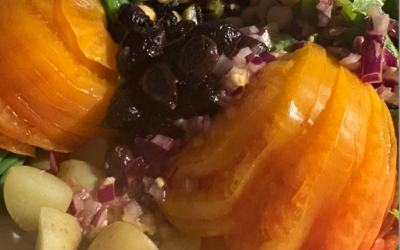
- I love to serve Bohémienne on a well laid table with e.g. a fresh green salad with a classic vinaigrette, fresh crusty bread, olives, a simple cucumber salad and rosemary roasted potatoes.
Bon appétit and share your results on Instagram using #closetclassics and/or tag Picnic en Provence!

0 Comments